
Your Car Has Been Keeping Secrets: Stop Neglect Before It Stops You
Preventative Maintenance Is Holding Your Vehicle Together More Than You Know
Preventative maintenance keeps Vehicle
” href=”https://midcolumbiainsurance.com/glossary/vehicle” data-mobile-support=”0″ data-gt-translate-attributes=”[{“attribute”:”data-cmtooltip”, “format”:”html”}]” tabindex=”0″ role=”link”>vehicles safe, prevents breakdowns, and directly shapes Insurance
” href=”https://midcolumbiainsurance.com/glossary/insurance” data-mobile-support=”0″ data-gt-translate-attributes=”[{“attribute”:”data-cmtooltip”, “format”:”html”}]” tabindex=”0″ role=”link”>insurance outcomes. Right now, your car may be carrying more accumulated problems than you realize. Close your eyes for a moment. It’s a clear Saturday morning in mid-April, the Tri-Cities are warming up, and you’re loaded and ready for the first road trip of the season, heading perhaps north on US-395 toward Spokane, WA
” href=”https://midcolumbiainsurance.com/spokane-wa” data-mobile-support=”0″ data-gt-translate-attributes=”[{“attribute”:”data-cmtooltip”, “format”:”html”}]” tabindex=”0″ role=”link”>Spokane or west on I-82 toward the Columbia River Gorge. About forty miles out, the dashboard begins telling you what you didn’t want to know. A warning light. Then a second. The steering pull you’ve been quietly compensating for since February finally announces itself as a tire failure. None of this happened overnight. Your car has been accumulating these problems since the first hard freeze, sending quiet signals through vibrations, longer stopping distances, and dashboard warnings you planned to deal with “when things slowed down.”
Seasonal vehicle wear compounds the way financial debt does: small, ignored problems don’t stay small. A cracked serpentine belt left unaddressed becomes an engine that stops dead at highway speed. Low coolant becomes an overheated engine on a hot Eastern Washington summer afternoon. Worn brake pads become metal-on-metal rotor damage that costs several times more to repair than the pads would have. The automotive aftermarket industry designated April as a national vehicle care awareness month in 2003 precisely because spring is when winter’s hidden damage becomes undeniable, and early enough in the year to correct problems before summer heat amplifies every mechanical weakness.
Deferred maintenance follows the same logic as ignoring your health: you don’t save money by postponing inevitable costs, you simply delay them until they become far more expensive and far more dangerous. Think of your vehicle the way you think of your own body. A person who skips every preventive appointment, ignores warning signs for months, and delays care until symptoms become a crisis doesn’t save money. They spend more, under worse conditions, at higher stakes. April is the annual checkup your vehicle has been waiting for, and National Car Care Month is the prompt the industry sends every spring to remind drivers that waiting costs more than acting.
“Running Fine” Does Not Means “Road Ready”
Vehicle owners across the country share a deeply human belief: if the car started this morning and completed the commute without incident, it must be fine. Modern vehicles reinforce this assumption by being engineered to keep running even as critical components approach failure. An engine operating on oil thousands of miles past its change interval doesn’t announce the damage with noise or smoke. It simply wears faster, quietly, until the deterioration is irreversible. The brain files “nothing dramatic happened today” under “fine” and moves on to the next concern.
Routine vehicle servicing gets postponed for understandable reasons: time, cost, and the absence of dramatic symptoms to create urgency. In Washington state, where spring driving conditions shift rapidly from rain-soaked mountain passes to the dry, windy roads of the Columbia Basin within a single drive, this assumption carries special Risk
” href=”https://midcolumbiainsurance.com/glossary/risk” data-mobile-support=”0″ data-gt-translate-attributes=”[{“attribute”:”data-cmtooltip”, “format”:”html”}]” tabindex=”0″ role=”link”>risk. The combination of freeze-thaw cycles, winter hard-braking on icy surfaces, and cold-start wear through January and February means a vehicle that survived winter didn’t necessarily come out of winter undamaged. It means the damage is still developing.
Deferred Vehicle Maintenance Affects Every Driver on Washington Roads
Deferred vehicle maintenance has reached a level that automotive safety researchers describe as a quiet crisis hiding in plain sight. Current data estimates that approximately 41% of vehicles on American roads are overdue for at least one critical maintenance service. The American Car
” href=”https://midcolumbiainsurance.com/glossary/car” data-mobile-support=”0″ data-gt-translate-attributes=”[{“attribute”:”data-cmtooltip”, “format”:”html”}]” tabindex=”0″ role=”link”>Automobile Association has separately documented that around 35% of car owners routinely neglect or postpone factory-specified maintenance. Apply those numbers to any stretch of US-395, SR-240, or I-82, and the reality becomes concrete: on a typical Washington road, nearly half the vehicles around you have a mechanical issue that is developing, worsening, or approaching failure right now.
Vehicle neglect is not a private financial decision. It is a behavior with consequences that extend to every other driver on shared roads. The Car Care Council documents that more vehicle fires trace back to deferred vehicle maintenance each year than to Accident
” href=”https://midcolumbiainsurance.com/glossary/accident” data-mobile-support=”0″ data-gt-translate-attributes=”[{“attribute”:”data-cmtooltip”, “format”:”html”}]” tabindex=”0″ role=”link”>accidents. Worn braking systems, bald tires, and failing steering components affect everyone in the surrounding traffic. The decision to skip a $100 oil change carries externalities that reach well beyond the driver who made it.
Automotive Research Makes Case for Spring Vehicle Inspections
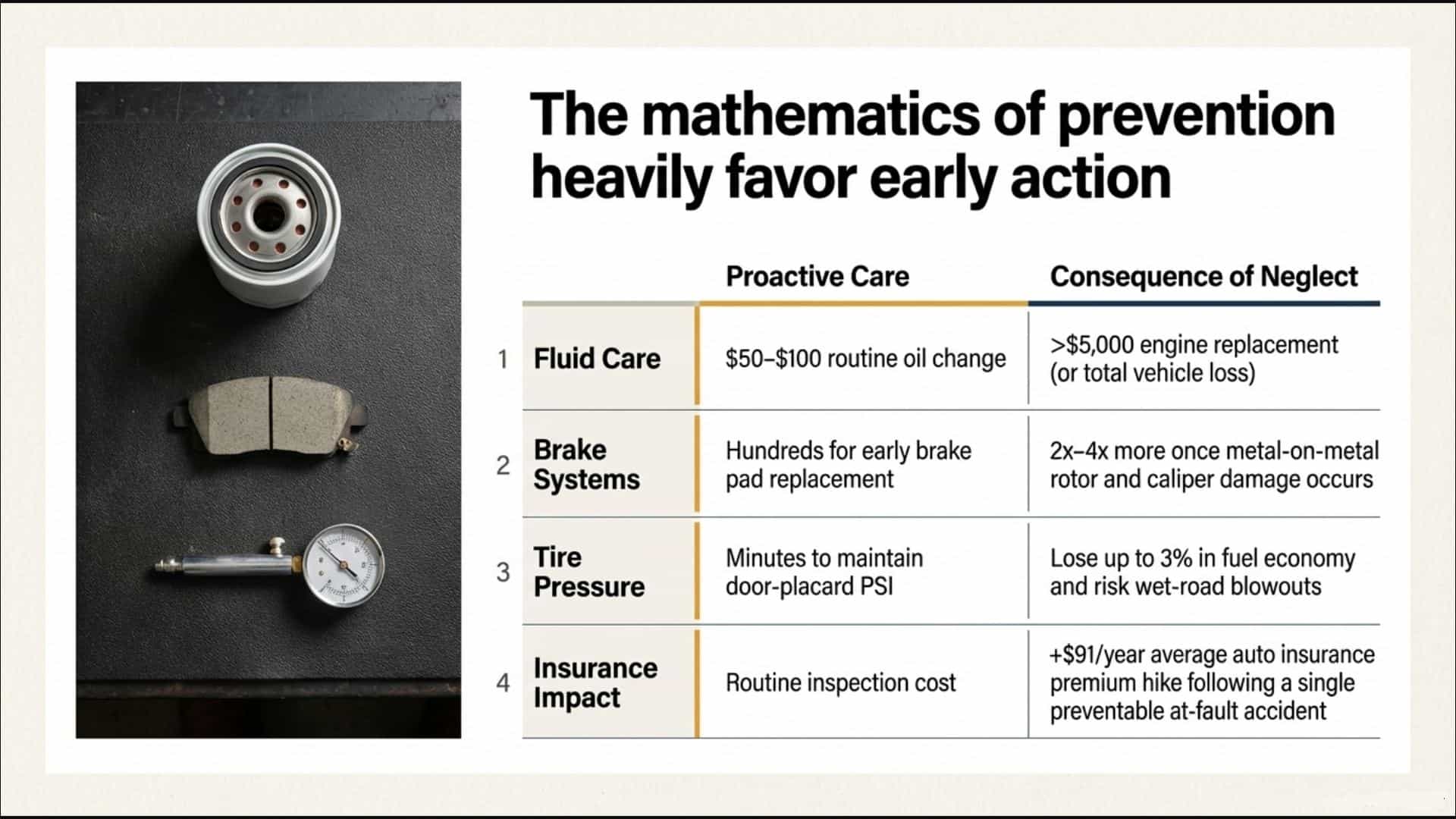
Automotive maintenance research consistently demonstrates that the cost of prevention is a fraction of the cost of repair. A routine oil change, typically priced between $50 and $100, prevents the kind of engine damage that routinely exceeds $5,000 in repair costs and can total a vehicle outright. Replacing brake pads before they wear through to the metal backing costs a few hundred dollars; replacing the rotors and calipers that worn brake pads destroy costs two to four times more, and that calculation still doesn’t account for the collision risk created by degraded stopping performance on Washington’s spring roads.
Tire safety data is equally direct. Adequate tread depth and correct inflation pressure are the two variables most closely linked to wet-road traction performance. Proper tire inflation alone can improve fuel economy by more than 3%, meaning correctly inflated tires essentially pay for the time it takes to check them within a few tanks of gas. Maintaining the PSI listed on your driver’s door placard is all it takes. Washington’s spring rainfall, even in Eastern Washington’s normally drier climate, creates exactly the wet-surface conditions where tire safety becomes a life-safety variable.
Insurance rate data connects vehicle condition to financial outcomes directly and measurably. A single at-fault accident of the kind that adequate brakes and proper tread depth can prevent raises the average Vehicle Insurance
” href=”https://midcolumbiainsurance.com/auto-insurance-agency” data-mobile-support=”0″ data-gt-translate-attributes=”[{“attribute”:”data-cmtooltip”, “format”:”html”}]” tabindex=”0″ role=”link”>auto insurance premium by approximately $91 per year. More serious at-fault accidents produce larger and longer-lasting rate impacts, persisting on a Washington driving record for up to three years and compounding through multiple renewal cycles. The arithmetic of prevention versus reaction is not close.
The Car Care Council recommends the following systems for inspection during National Car Care Month:
| Vehicle System | What to Inspect | Warning Signs |
|---|---|---|
| Engine oil | Level, color, service interval | Dark or gritty oil; burning smell |
| Coolant / antifreeze | Level, condition, concentration | Low level; discolored fluid |
| Brake fluid | Level and color | Dark fluid; spongy pedal feel |
| Transmission fluid | Level and color | Low level; delayed or rough shifts |
| Power steering fluid | Level | Low level; stiff or unresponsive steering |
| Windshield washer fluid | Level | Empty reservoir |
| Tires | Pressure, tread depth, rotation status | Uneven wear; visible tread wear indicators |
| Brake pads and rotors | Pad thickness, rotor surface condition | Squealing; grinding; steering vibration |
| Battery | Charge level, terminal corrosion | Slow cranking; visible terminal corrosion |
| Belts and hoses | Cracks, fraying, proper tension | Visible cracking; belt squeal |
| Engine air filter | Visual condition | Visibly dirty or clogged filter element |
| Cabin air filter | Visual condition | Reduced airflow; persistent interior odors |
| Wiper blades | Contact quality, streak-free operation | Streaking; skipping; squeaking |
AAA Washington members have a specific advantage during April: free vehicle inspections are available at AAA Approved Auto Repair locations throughout the state during National Car Care Month. For Tri-Cities area drivers, this is a zero-cost opportunity to remove every excuse for putting off the spring inspection.
Auto Insurance Covers Accidents, But It Cannot Cover the Neglect That Causes Them
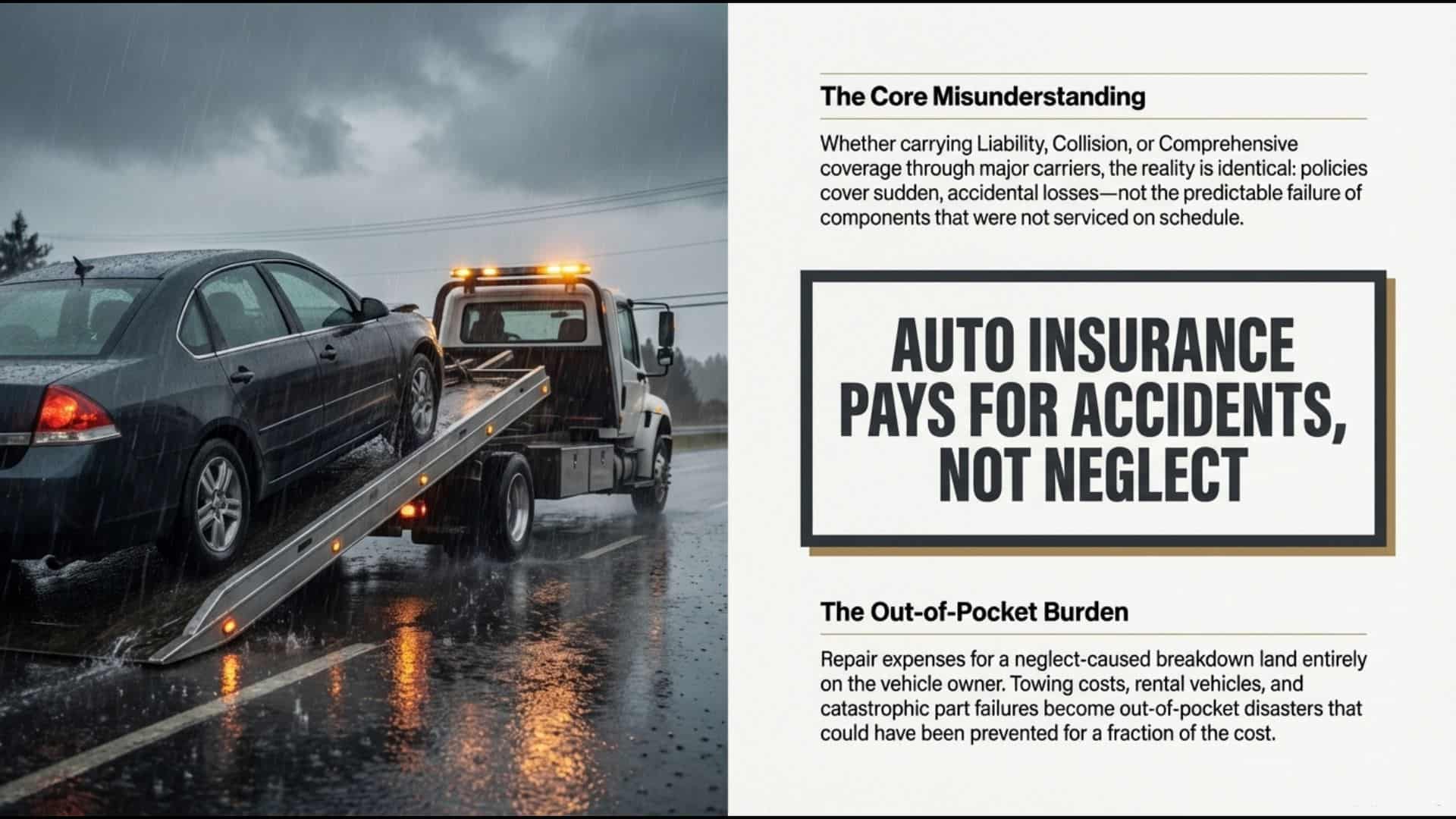
Auto insurance coverage, whether it includes liability, collision coverage, or Other Than Collision (comprehensive) protection, does not cover mechanical breakdowns caused by normal use and deferred service. This is one of the most consequential misunderstandings in personal vehicle ownership. Drivers insured through carriers like The General Insurance
” href=”https://midcolumbiainsurance.com/the-general-insurance” data-mobile-support=”0″ data-gt-translate-attributes=”[{“attribute”:”data-cmtooltip”, “format”:”html”}]” tabindex=”0″ role=”link”>The General, Safeco Insurance
” href=”https://midcolumbiainsurance.com/safeco-insurance” data-mobile-support=”0″ data-gt-translate-attributes=”[{“attribute”:”data-cmtooltip”, “format”:”html”}]” tabindex=”0″ role=”link”>Safeco, Bristol West Insurance
” href=”https://midcolumbiainsurance.com/bristol-west-auto-insurance” data-mobile-support=”0″ data-gt-translate-attributes=”[{“attribute”:”data-cmtooltip”, “format”:”html”}]” tabindex=”0″ role=”link”>Bristol West, Progressive Insurance
” href=”https://midcolumbiainsurance.com/progressive-insurance” data-mobile-support=”0″ data-gt-translate-attributes=”[{“attribute”:”data-cmtooltip”, “format”:”html”}]” tabindex=”0″ role=”link”>Progressive, Dairyland Insurance
” href=”https://midcolumbiainsurance.com/dairyland-insurance” data-mobile-support=”0″ data-gt-translate-attributes=”[{“attribute”:”data-cmtooltip”, “format”:”html”}]” tabindex=”0″ role=”link”>Dairyland, and National General Insurance
” href=”https://midcolumbiainsurance.com/national-general-insurance” data-mobile-support=”0″ data-gt-translate-attributes=”[{“attribute”:”data-cmtooltip”, “format”:”html”}]” tabindex=”0″ role=”link”>National General share the same fundamental policy reality: insurance pays for sudden, accidental losses, not the predictable failure of components that weren’t serviced on schedule.
Repair expenses for a neglect-caused breakdown land entirely on the vehicle owner: towing costs, a rental vehicle, and a repair that would have cost a fraction of its current price had it been addressed at the scheduled service interval. Beyond that first financial layer: if a mechanical failure contributes to a collision, Washington state’s comparative fault system means the vehicle’s maintenance history enters the liability analysis. A driver whose tire failed because tread depth had been unsafe for months, or whose brakes were documented as inadequate at a prior inspection, faces legal exposure even in cases where another driver bears primary fault for the collision.
Vehicle resale value takes a measurable, documented hit without an on-schedule maintenance history. Identical vehicles sharing the same year, make, model, and mileage sell at significantly different prices depending on whether maintenance records exist and show consistent, on-interval service. The value of documented maintenance frequently exceeds its cost. The damage of neglect shows up in the repair bill, in the insurance premium, and ultimately in the vehicle’s sale price.
Spring Vehicle Maintenance: Your Step-by-Step Action Plan for Washington Drivers
Spring vehicle inspections give every Washington driver a structured, actionable path back to safe operating condition, and the steps involved are neither technically complex nor prohibitively expensive. Washington’s Auto Repair Act requires all licensed repair facilities in the state to provide written estimates before beginning work and prohibits charging above the authorized estimate without customer approval. There is no basis for avoiding a professional inspection out of concern about being overcharged. State law provides clear consumer protections.
Here is a prioritized spring maintenance plan for drivers in Eastern Washington and the Tri-Cities area:
Begin with safety-critical systems:
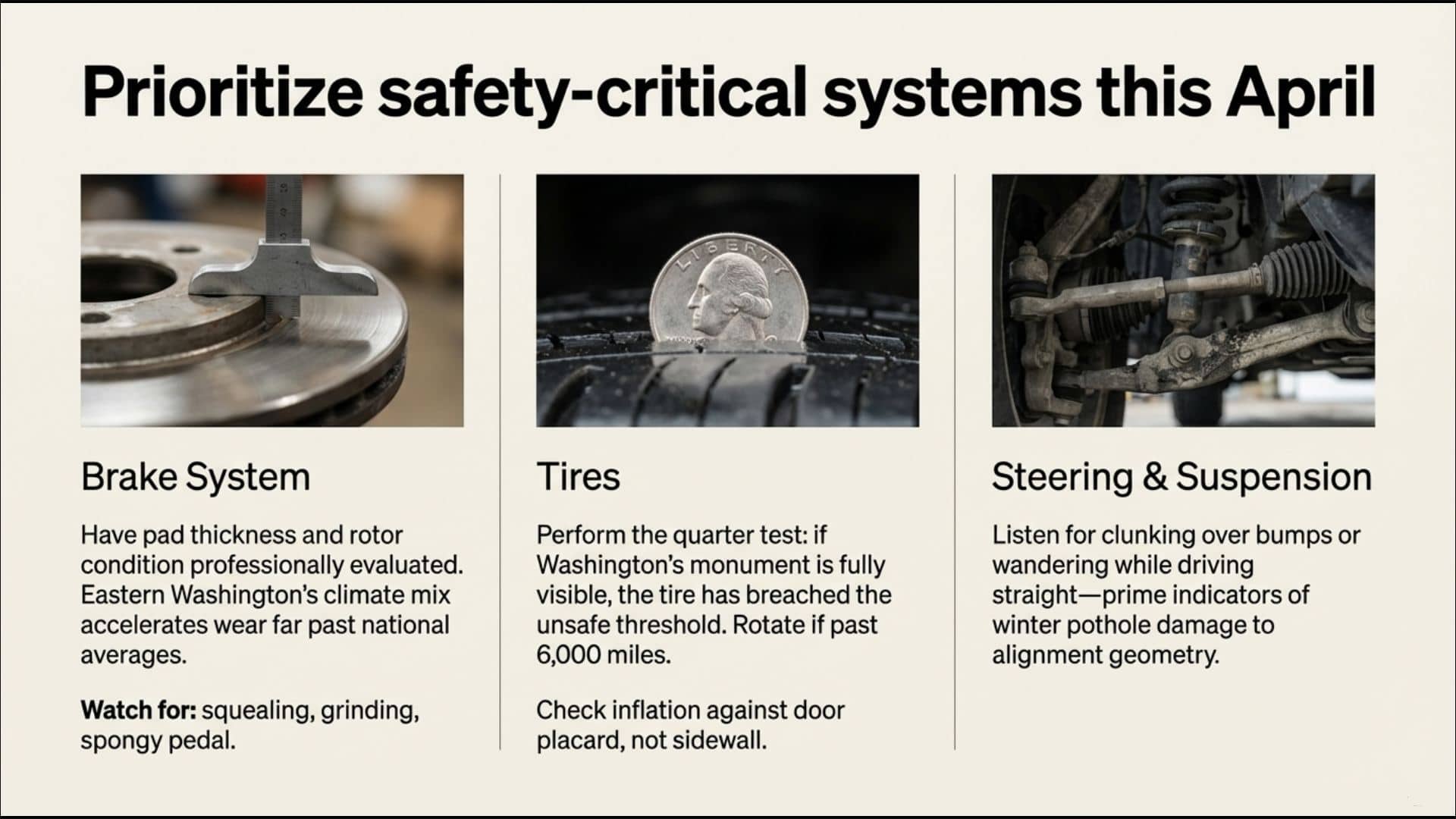
- Brake system inspection: Have pad thickness and rotor condition evaluated professionally, particularly if you notice any squealing, grinding, or extended stopping distances. Eastern Washington’s combination of summer heat and winter hard-braking cycles accelerates brake wear faster than national averages, making this the highest-priority item on the spring list.
- Tire inspection and rotation: Check inflation pressure against the PSI specified on your driver’s door placard (not the sidewall maximum). Insert a quarter into the main tread groove: if Washington’s monument is fully visible above the tread, the tire is approaching the unsafe threshold. Schedule a tire rotation if the last one was more than 6,000 miles ago.
- Steering and suspension assessment: Listen for clunking sounds over bumps and notice any pulling or wandering while driving straight. Both can indicate that winter pothole impacts, common on Eastern Washington roads after freeze-thaw cycles, have affected alignment or suspension geometry.
Then address fluid systems:
- Engine oil level and condition: dark, gritty oil should be changed immediately
- Coolant level and concentration: check this before Eastern Washington’s summer temperatures create overheating risk
- Brake fluid level and color: discolored fluid should be replaced by a professional
- Windshield washer fluid: spring pollen in the Columbia Basin makes this a near-daily consumption item for most drivers
Follow with visibility and electrical systems:
- Replace wiper blades that streak or skip, because spring rainfall doesn’t wait for a convenient appointment
- Test all exterior lighting: headlights, taillights, brake lights, and turn signals
- Have the battery tested professionally. Cold winter starting stress can deplete battery capacity significantly, and a battery that made it through winter may not survive an Eastern Washington summer
Close with filters and documentation:
- Replace the engine air filter if it’s visibly restricted or past its service interval
- Replace the cabin air filter. Allergy season in the Columbia Basin is genuinely intense, and a clogged filter makes it significantly worse
- Collect all service receipts and store them with the vehicle. This creates documentation that supports both resale value and insurance conversations
Once the vehicle is road-ready, April is the ideal time to pair that maintenance work with an Insurance Policy
” href=”https://midcolumbiainsurance.com/glossary/insurance-policy” data-mobile-support=”0″ data-gt-translate-attributes=”[{“attribute”:”data-cmtooltip”, “format”:”html”}]” tabindex=”0″ role=”link”>insurance policy review. Gary Paulson
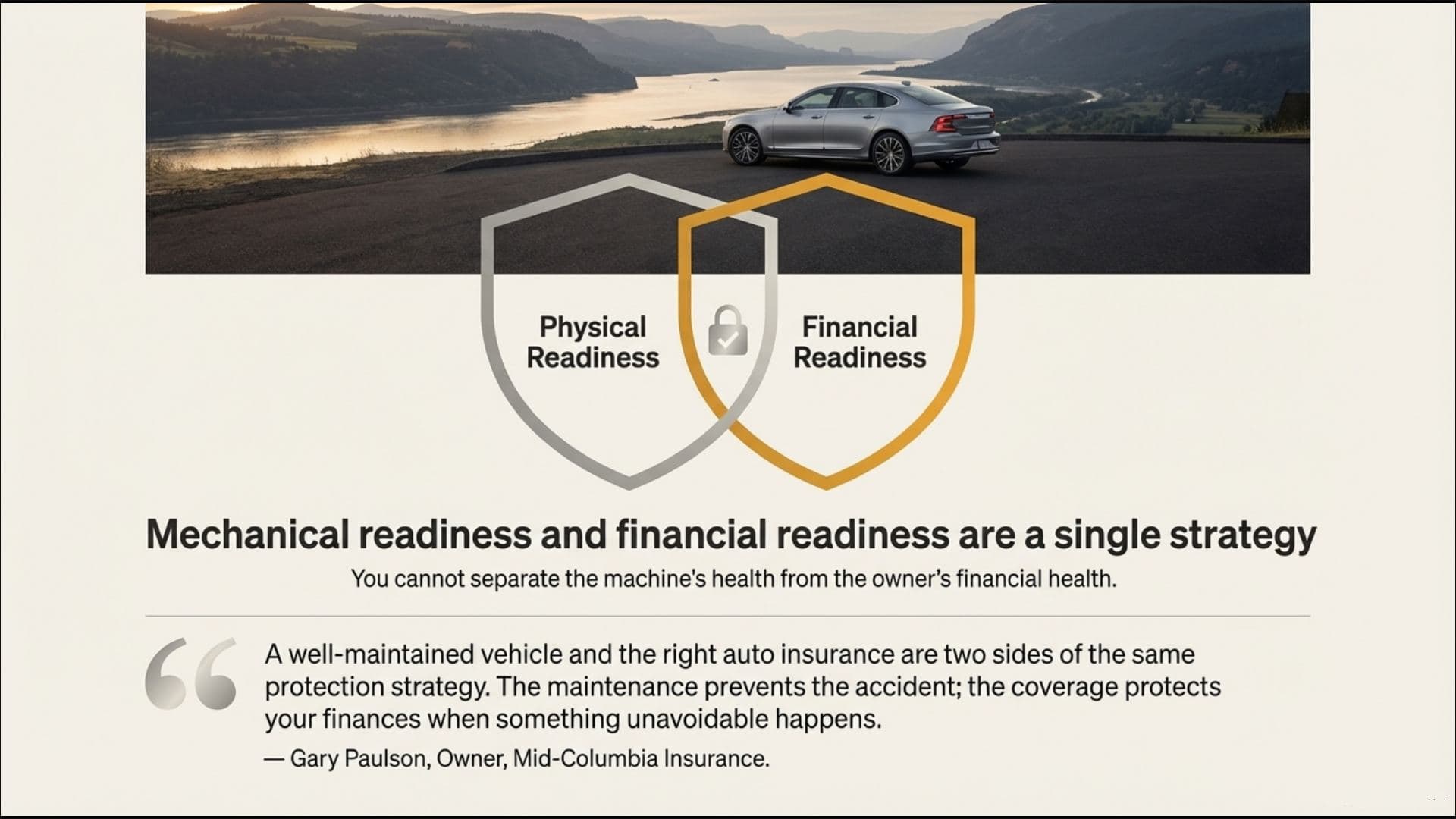
” href=”https://midcolumbiainsurance.com/gary-paulson” data-mobile-support=”0″ data-gt-translate-attributes=”[{“attribute”:”data-cmtooltip”, “format”:”html”}]” tabindex=”0″ role=”link”>Gary Paulson, owner of Mid-Columbia Insurance, makes the connection clear: “A well-maintained vehicle and the right auto insurance are two sides of the same protection strategy. The maintenance prevents the accident; the coverage protects your finances when something unavoidable happens. Reviewing your policy every spring, at the same time you review your car, is just smart risk management.”
Liability Insurance
” href=”https://midcolumbiainsurance.com/glossary/liability-insurance” data-mobile-support=”0″ data-gt-translate-attributes=”[{“attribute”:”data-cmtooltip”, “format”:”html”}]” tabindex=”0″ role=”link”>Liability coverage limits deserve priority attention during any spring policy review. Washington state’s minimum liability requirements of 25/50/10 are widely considered insufficient for the actual costs of a serious modern accident. Medical expenses alone for a hospitalized accident victim can exceed state minimums in a single billing cycle, leaving an at-fault driver personally responsible for the remainder. Upgrading liability limits is typically far less expensive than most drivers expect.
Coverage limit alignment between liability and UM/UIM is the step most commonly overlooked. Washington law requires insurers to offer Uninsured Motorist
” href=”https://midcolumbiainsurance.com/faq/what-is-uninsured-motorist-coverage” data-mobile-support=”0″ data-gt-translate-attributes=”[{“attribute”:”data-cmtooltip”, “format”:”html”}]” tabindex=”0″ role=”link”>Uninsured/Underinsured Motorist coverage, but many drivers carry UM/UIM limits that fall well below their liability limits. Aligning the two is a straightforward policy adjustment that provides meaningful protection in hit-and-run scenarios and collisions with underinsured drivers, and neither scenario is rare on Washington roads.
Independent Insurance Agencies Offer Comparison Shopping
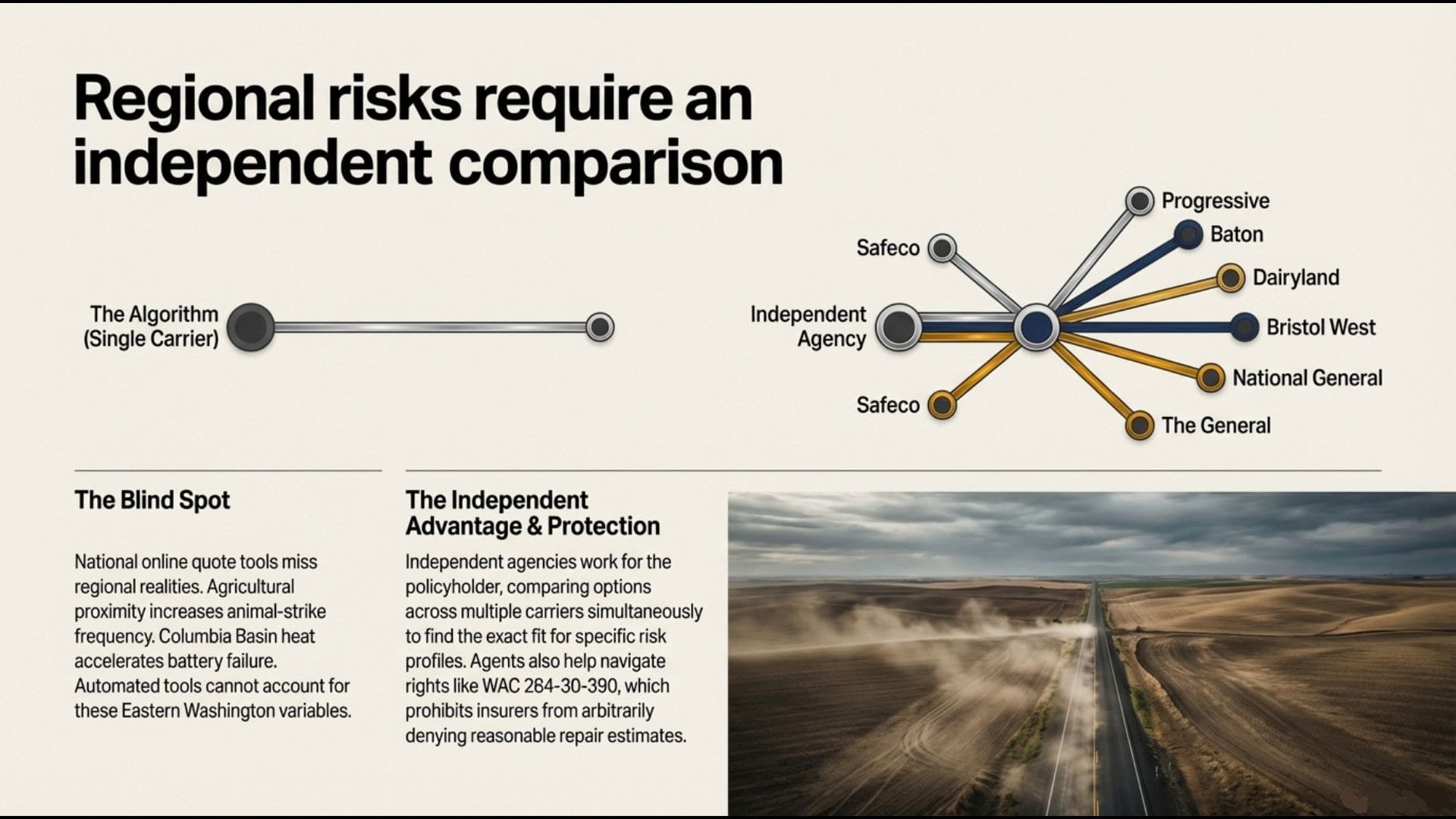
Independent insurance agencies represent multiple carriers and work for the policyholder rather than the Insurance Company
” href=”https://midcolumbiainsurance.com/glossary/insurance-company” data-mobile-support=”0″ data-gt-translate-attributes=”[{“attribute”:”data-cmtooltip”, “format”:”html”}]” tabindex=”0″ role=”link”>insurance company, and that structural difference produces meaningfully better outcomes for consumers. When Mid-Columbia Insurance reviews a driver’s coverage, the process compares options across National General, Safeco, Progressive, The General, Bristol West, and Dairyland simultaneously, finding the combination of coverage depth and premium cost that fits each driver’s specific situation rather than the one carrier’s Underwriting
” href=”https://midcolumbiainsurance.com/glossary/underwriting” data-mobile-support=”0″ data-gt-translate-attributes=”[{“attribute”:”data-cmtooltip”, “format”:”html”}]” tabindex=”0″ role=”link”>underwriting model has decided is standard.
Eastern Washington’s regional risk profile differs from western Washington in ways that national online quote tools routinely miss. Agricultural area proximity increases animal-strike claim frequency substantially. Hot, dry summers in the Columbia Basin accelerate tire wear and battery failure at rates above the national baseline. The Tri-Cities’ unique wind patterns create hazards that don’t appear in the risk models built from western Washington data. Experienced independent agents who understand these regional factors guide coverage decisions in ways that automated tools simply cannot replicate.
Consumer protection provisions under Washington state law extend to both vehicle repairs and insurance claim handling. Under WAC 284-30-390, insurers cannot arbitrarily deny reasonable repair estimates and must provide written justification for any reduction below a claimant’s chosen shop estimate. Knowing these rights exist, and having a knowledgeable agent available to help exercise them, matters when a claim becomes complex or disputed.
Road-Ready Vehicles and Good Insurance Coverage Are April’s Best Combination
Road-ready vehicles and well-structured insurance protection function as a unified system: the preventative maintenance reduces the likelihood of an incident, and the coverage limits financial exposure when something unavoidable happens despite a driver’s best efforts. April, the month of National Car Care Month, is the annual prompt to confirm that both halves of that system are functioning as intended.
The path forward is clear and actionable:
- Complete a spring safety inspection: use AAA Washington‘s free April program, a Washington Auto Repair Act-protected licensed repair facility, or the Car Care Council‘s free checklist at carcare.org
- Work through the full spring maintenance protocol covering brakes, tires, fluids, battery, filters, lights, and wipers, using the table above as your guide
- Save all service receipts and create a vehicle maintenance log for resale documentation and insurance reference
- Schedule a free insurance review with Mid-Columbia Insurance to compare coverage limits, UM/UIM alignment, and available rates across multiple carriers
- Confirm that liability limits and coverage structure reflect your vehicle’s current value, your driving patterns, and your actual risk tolerance
Spring preparedness is not a seasonal chore. It is an active financial strategy. Washington drivers who treat April as an annual reset point for both their vehicle and their coverage consistently spend less on unexpected repairs, maintain more stable premiums, and navigate the inevitable surprises of life on the road with far less financial pain than those who don’t make the investment. That outcome is available to every driver who decides to pursue it this month.
Mid-Columbia Insurance serves drivers throughout the Tri-Cities area and Eastern Washington, offering access to multiple carriers including Safeco, Progressive, Dairyland, Bristol West, National General, and The General, with honest comparisons and no pressure to purchase more coverage than your situation requires.
Frequently Asked Questions
Does Washington require emissions testing, and does a failed test affect registration renewal
The Evergreen State requires emissions testing in certain counties as a condition of vehicle registration renewal through the Vehicle/Air Check program. The program applies primarily to counties in western Washington and the greater Puget Sound region. Vehicles that fail the test must be repaired and pass a retest before registration can be renewed. Many Eastern Washington counties, including the Tri-Cities area, are not currently subject to the program’s testing requirements.
What credentials should I look for when choosing an auto repair shop in Washington?
Look for facilities staffed by ASE-certified technicians (Automotive Service Excellence), which signals tested and verified mechanical knowledge across specific repair categories. The AAA Approved Auto Repair designation requires shops to pass regular independent inspections and maintain documented customer satisfaction standards. Membership in the Automotive Service Association (ASA) is another positive indicator of professionalism. Checking Google Reviews and the Better Business Bureau can help verify a shop’s track record before committing to service.
What is a multi-point inspection, and how is it different from a standard oil change?
A multi-point inspection is a systematic evaluation of 20 to 50 vehicle systems, typically covering brake components, tire condition and pressure, all fluid levels, battery health, belts and hoses, steering and suspension geometry, and exterior lighting. A standard oil service addresses only engine oil and the oil filter. Most repair shops include a complimentary multi-point vehicle check alongside any oil service appointment. During April, AAA Washington members can request a free standalone vehicle inspection at any AAA Approved Auto Repair location without scheduling an oil change.
What does a check engine light mean, and how urgent is it?
A check engine light, also called the malfunction indicator lamp (MIL), signals that the vehicle’s onboard diagnostic system (OBD-II) has detected a fault in the engine, emissions control system, or transmission. A steady light typically indicates a real but non-urgent issue. A flashing light signals a more serious problem requiring prompt attention to prevent catalytic converter damage or further engine harm. The light will not resolve on its own without addressing the root cause. Any licensed repair facility can connect a diagnostic scanner to read the stored fault codes and pinpoint the source.
What is the difference between the April vehicle care campaign and Fall Car Care Month?
Both campaigns are organized by the Car Care Council, now part of the Automotive Aftermarket Industry Association. The spring campaign focuses on undoing winter damage and preparing vehicles for warm-weather driving and summer road trips. Fall Car Care Month, held each October, targets winter preparedness, with emphasis on antifreeze concentration, heating system performance, battery condition, and cold-weather tire readiness. Together they create a practical twice-yearly maintenance framework that covers the full range of seasonal driving demands.
What exactly is the “Be Car Care Aware” program?
Be Car Care Aware is the consumer education initiative managed by the Car Care Council. It provides free vehicle maintenance checklists, a repair shop locator, and service interval guidance at carcare.org. The program also funds industry research that documents how many vehicles on American roads are overdue for service and supports driver education as a road safety tool nationwide. It is the public-facing arm of the broader vehicle care awareness movement.
How often should oil changes, tire rotations, and brake inspections actually be scheduled?
Your owner’s manual is the authoritative source, but general guidelines are as follows. Oil changes are recommended every 5,000 to 7,500 miles with conventional oil, or every 10,000 to 15,000 miles with full synthetic motor oil. Tire rotation should occur every 5,000 to 7,500 miles. A brake system inspection is appropriate at least once per year or any time squealing, grinding, or extended stopping distance appears. Battery testing is recommended every two to three years. April’s vehicle care awareness campaign is a practical annual checkpoint to review all of these intervals at once.
Ready to pair a road-ready vehicle with the right coverage this April?
Call Mid-Columbia Insurance at (509) 783-5600 or visit MidColumbiaInsurance.com to request your free insurance review today. Because the best protection is always the kind you put in place before you need it.
Information contained on this page is provided by an independent third-party content provider. This website make no warranties or representations in connection therewith. If you are affiliated with this page and would like it removed please contact editor @producerpress.com