
Report: Billions of Dollars in Data Center Construction Risk Is Uninsured
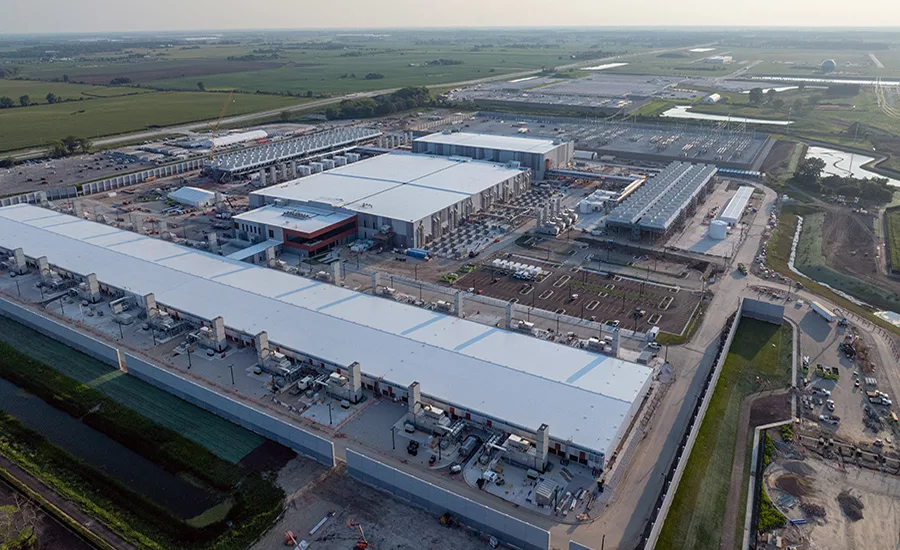
Annual investment in data centers could surpass $300 billion by 2027, according to S&P Global Ratings—and as hyperscale campuses push total insurable values to between $10 billion and $30 billion per location, the insurance market that traditionally underpins large construction projects is struggling to keep pace.
“The biggest change we see right now is the size and scale of these data centers,” says Sedat Kunt, national builders’ risk practice leader at Marsh McLennan. “Two years ago … maybe $1 billion to $2.5 billion in size. Now they seem to be anywhere between $5 billion to $25 billion.”
That rapid escalation has broken a long-standing industry norm of insuring projects to full replacement value.
“You can’t really buy $20 billion insurance on a $20 billion project,” Kunt explains. “We changed our approach.”
A Market of Unprecedented Scale
S&P Global Ratings, in an April 13 analyst report, estimates that roughly 11,000 data centers are currently in operation globally, representing a total insurable asset base of more than $2 trillion. The firm projects that rising demand could generate $10 billion in new insurance premiums in 2026 alone—roughly twice the annual premiums generated by the global aviation insurance market.
Swiss Re similarly estimates that the global premium pool tied to data centers could grow from about $10.6 billion today to $24.2 billion by 2030.
The rapid growth of these projects has drawn a complex web of stakeholders—hyperscalers, developers, builders, utility providers, equity investors and lenders—each carrying distinct insurance requirements. S&P expects specialized insurers and reinsurers to expand capacity in response, but cautions that no single carrier can absorb the risks alone, making collaborative structures and alternative capital increasingly central to how the market functions.
Looking for quick answers on construction and engineering topics?
Try Ask ENR, our new smart AI search tool.
Ask ENR →
Coverage Falls Short of Project Value
Instead of matching coverage to total construction cost, insurers are now underwriting data centers based on probable maximum loss, or PML—an engineering-driven estimate of the largest likely loss from perils such as fire or severe weather.
Kunt says that analysis now routinely includes multiple scenarios, noting that most hyperscale campuses are sited in tornado-exposed regions, requiring a separate tornado PML alongside fire risk modeling.
“If you bring in today a $10 billion project … my starting level will be $2.5 billion,” Kunt said, noting that limits are refined through detailed risk modeling. Across Marsh’s book of business, the policy limit of liability for mega data centers “tends to be anywhere between $1.5 billion and $3.5 billion,” he said, adding that he is aware of only three industry placements that have exceeded $5 billion.
Read More: Analysis Report
Data Centers Offer a Hyperscale Pool of Insurable Risks
Hyperscale data centers are rapidly becoming a multi-trillion-dollar concentration of insurable assets, driving premium growth and new insurance structures. Their $10 billion–$30 billion site values strain market capacity and pose aggregation and business-interruption risks beyond traditional infrastructure, according to S&P Global Ratings.
Read the full analysis.
Image: Adobe
That leaves a significant portion of project value outside conventional insurance structures—a gap S&P Global Ratings has now directly quantified. Patricia Kwan, a primary analyst for S&P’s data center insurance research, estimated that the insured portion amounts to “only a third, maybe at best half” of total campus value, with the balance effectively retained by hyperscale developers.
Her colleague Charles-Marie Delpuech observed that this gap reflects both capacity limits and underwriting discipline. “The gap is really on those hyperscale data centers, and the gap will persist as long as they are that big and the insurance market is not providing those covers,” he said. “We see the industry remaining disciplined and cautious in the way they go into that space.”
The exposure profile underlying those limits is reinforced by third-party data. Swiss Re estimates that more than 40% of U.S. data center capacity is located in areas significantly exposed to tornado risk, with more than one-quarter exposed to substantial hail risk—conditions that directly influence PML modeling and underwriting assumptions.
The coverage gap is compounded by how builders’ risk is structured. Kunt says most policies only cover core and shell construction. Once owners and tenants begin install high-value computing hardware the risk is covered under separate operational property programs.
“In order to get to more limits, you need to tap into certain capacity like FM Global,” Kunt says, referring to the specialty insurer known for its stringent building-design requirements. “It’s always helpful to partner with FM Global and then have a holistic approach—not just taking care of the builders’ risk while it’s being built, but what type of limits we would require [at the operational stage].”
“[Data centers] are not just buildings, they are highly integrated systems where you have power, cooling, hardware and software that all depend on each other,” explains Jimmy Keime, head of engineering and nuclear at Swiss Re.
RELATED
When Builders’ Risk Insurance Starts Dictating Jobsite Decisions
How Contractors and Owners Are Absorbing the Gap
The mismatch is not lost on contractors tasked with delivering these campuses.
“We’re seeing a lot of builders’ risk policies on megaprojects where there is not enough coverage for the full project value,” says Amy Iannone, insurance and risk management leader at Santa Clara, Calif.-based DPR Construction.
To bridge the gap, projects increasingly rely on layered structures involving multiple carriers.
“We’re also seeing a lot of policies with multiple carriers participating in a quota share so the insurers aren’t committing too much capacity to one project,” Iannone adds.
As data center spending accelerates, insurers are scaling coverage based on probable maximum loss rather than full project value—leaving as much as half of hyperscale campus costs uninsured, according to S&P Global Ratings.
Source: U.S. Census Bureau/Swiss RE
While coverage limits have tightened relative to project size, risk has not disappeared—it is being redistributed across owners, contractors and capital providers. S&P noted that insurability directly affects capital formation, financing costs and project viability, while Swiss Re says lenders are pressing for limits that cover full construction costs—demands the market cannot meet at commercially viable rates.
“I think owners are retaining risk, but it’s calculated risk,” Kunt says. Depending on financing requirements and risk tolerance, some projects may secure coverage of “$5 billion or $6 billion,” he adds.
“Working with our long-standing carrier partners, we have been able to structure programs that support these projects,” Iannone explains. “The carriers want to be a part of these projects and have been willing to work outside of their standard operating procedures.”
The compressed timeline between preconstruction and groundbreaking has added pressure.
“The time from preconstruction to construction has shortened substantially,” she says, “so we develop strategies to get project-specific insurance programs built quickly.”
On large, phased campuses, Iannone says projects increasingly rely on phasing endorsements that allow coverage to roll off completed portions while construction continues elsewhere. “They’re helpful for managing costs,” but require constant coordination. “The challenge is keeping the carrier up to date on schedule and scope changes as the project evolves and progresses.” She adds that new insurance products aimed at improving protection during phased turnovers are emerging, though adoption remains early.
A key constraint is delay-in-startup insurance, which protects against lost revenue if a project is delayed by an insured peril during construction.
“Once you introduce delay in startup … the capacity starts shrinking,” Kunt notes. Lost rental income on a hyperscale campus can rival construction costs, “in some cases, almost equal to the amount of construction cost.”
Without that requirement, insurers could deploy significantly more capital. “We can place limits actually upwards of $8 billion, $9 billion if needed,” Kunt says. Once business interruption exposure is included, however, “it gets costlier” and harder to place.
RELATED
Close the Gaps in Data Center Project Insurance Policies, Say Risk Managers
New Capacity, Unproven at Scale
Marsh’s Nimbus program—the first insurance facility of its kind for large-scale data center construction, launched in June 2025—now offers up to $2.7 billion in limits, inclusive of delay-in-startup and business interruption coverage, for projects in the U.S., UK, Canada, Europe, Australia and New Zealand.
U.S. data center capacity is increasingly concentrated in regions with elevated tornado and hail exposure, reinforcing insurers’ reliance on probable maximum loss modeling and contributing to tighter coverage limits for hyperscale projects.
Charts courtesy of Swiss RE
Aon plc expanded its Data Center Lifecycle Insurance Program to $3.5 billion in April 2026—adding $1 billion in capacity and extending the program’s scope to include existing data centers entering long-term operations. That lifecycle extension directly addresses the structural gap Kunt identified: builders’ risk coverage terminates at substantial completion, leaving the equipment-loaded campus to be picked up by a separate operational property program. The program now provides coordinated coverage across that transition.
The driver behind that design is a risk that conventional program structures leave unaddressed. On large-phased campuses, live data halls and active construction occupy the same footprint simultaneously—and that adjacency creates a distinct exposure.
“A construction-phase incident can damage an operational data hall, triggering a highly complex claim that may touch multiple policies and stakeholders,” says Caroline St. Clair, North America Digital Infrastructure Lifecycle Practice Leader at Aon. Fragmented separate placements for construction and operations leave that exposure uncoordinated; a unified lifecycle program addresses it directly, she adds.
But even the highest available limits fall short of the largest campuses under development, reinforcing the need for multi-layered programs and retained risk.
Despite the scale of exposure, the sector has not yet seen a major loss at hyperscale levels, but that may be masking underlying fragility in the market.
Swiss Re estimates that a single data center site could generate close to $10 billion in natural catastrophe losses—roughly 9% of total global insured catastrophe losses in 2025.
“There’s so much capacity right now in the market,” Kunt said, estimating that insurers could absorb a loss of “$2 billion or $2.5 billion.” But he cautioned that the industry is reactive. “If that happens … there will be [a] harder look at [pricing and underwriting].”
There is also a growing concern that a concentration of assets is creating overlapping risk exposures.
“Most of these data centers are now being built in close proximity to each other, and that creates an aggregation issue for insurance companies,” Kunt said. “Cluster all these into a certain zip code … and that will become an issue of finding the limits that you require at a commercially viable price.”
He described the dynamic as “probably one of the … time bombs waiting to happen,” noting that a single event could simultaneously stress builders’ risk, workers’ compensation and liability programs held by the same insurer across co-located campuses.
The exposure is also larger than any individual project value might suggest. On frontier AI campuses—with a gigawatt or more of power capacity and onsite power generation—the data center developer, the hyperscaler tenant and the insurance provider may all be seeking insurance at the same address, each with separate coverage.
“Cumulative values across all stakeholders at one campus can easily exceed $50 billion,” St. Clair said. “That presents significant aggregation risk for insurance and reinsurance markets that are often deploying capacity to each of those parties.”
S&P similarly identified aggregation risk—from natural catastrophes, supply chains and cyber threats—as a key consideration in its ongoing credit rating analysis.
RELATED
1Q 2026 Cost Report: Data Centers Propping Up a Fragile Construction Market
Beyond Traditional Markets
“There will be insurance solutions backed by alternative capital markets—like catastrophe-bond-type coverage—because you need to find other sources of capital when there is a lack of capacity from the traditional market,” Delpuech noted in the S&P report, projecting that insurance-linked securities will begin providing capacity as the sector develops.
For now, development continues to accelerate. S&P projects that data centers will account for about 14% of U.S. power demand by 2030, up from 5% in 2025, driving parallel investment across energy and utility infrastructure.
Kunt says hyperscale campuses in the $10 billion to $25 billion range remain largely a U.S. phenomenon and flagged energy supply as the most significant long-term structural constraint on the sector.
“We’re going to overbuild these things,” he adds. “I don’t think we have enough power … if we want to basically fire these things up.”
Until then, the industry is operating under a new risk model—one in which full insurance coverage is no longer the default, billions of dollars in exposure remain on balance sheets or flow through captive structures, and a capacity market drawing on layered programs and alternative capital has yet to face its first major test.
Information contained on this page is provided by an independent third-party content provider. This website make no warranties or representations in connection therewith. If you are affiliated with this page and would like it removed please contact editor @producerpress.com